
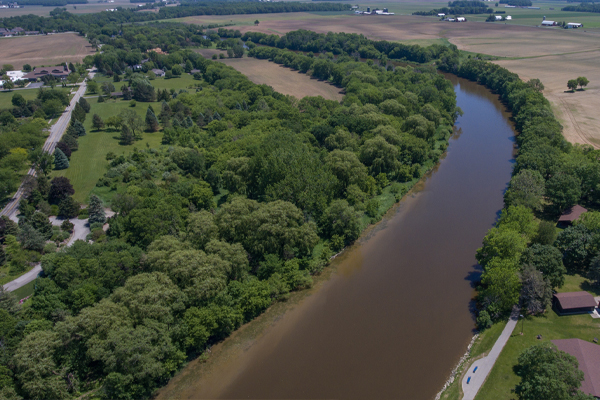
In 1831 Alex de Tocqueville, a reporter for a Paris newspaper, was sent to America to write about the edge of civilization, “the last frontier,” wherein his travels brought him to Saginaw, Michigan. On that trip he wrote his impressions of the Cass River: “A turf covered point projecting above the river in the shade of great trees served us as a table and we sat down to luncheon with a view of the river whose waters clear as crystal, snaked through the wood.” Since 1831 there has been a dramatic change in how land is used in the watershed. Swamps and forests have been transformed into farm fields, homes, pastures, roads and towns. Over time, the change in the landscape has changed the health and ecosystem of the Cass River. Once clear waters now often run a muddy brown color as rain water carries excess dirt, trash, chemicals and organic waste off the land into storm drains and ditches and into the river.
Wouldn’t it be great to see the Cass River crystal clear again? That in part is what motivated a local group of citizens to form the Cass River Greenway Committee in 2007.
Today, the Cass River Greenway continues as a group of volunteers, supported by municipal leaders along with county, state and federal agencies whose mission is to promote recreation and the environmental well-being of the Cass River.
Specifically, our goals include:
Develop Recreation Opportunities on the Cass River and along its corridor
Encourage Preservation of Wildlife Habitat and Critical Natural Lands
Improve Water Quality of the Cass River
Agency support has been provided by: MDEQ (EGLE) Water Bureau, UM Flint, US Fish & Wildlife Service, USDA/Saginaw RC&D, Saginaw Basin Land Conservancy, Saginaw Area Storm Water Authority, US National Park Service, Saginaw and Tuscola County Conservation Districts, Saginaw and Tuscola County Road Commissions, The Nature Conservancy - Saginaw Bay Watershed Initiative Network (WIN), and Michigan Department of Natural Resources. In addition, various foundations, businesses and individual donors have supported a wide range of projects that have positively impacted the Cass River Greenway’s mission.
Following is a report of the efforts and accomplishments of the Cass River Greenway since its inception in 2007:
Develop Recreation Opportunities on the Cass River and along its corridor
The primary focus of our recreation goal has been the establishment of a Cass River WaterTrail. In 2007, recreation on the Cass River was primarily limited to fishing and boating/pontoon enjoyment. Public access was available from boat launches in Saginaw, Bridgeport, Frankenmuth and Caro. Each of these locations provided water depths sufficient for boat traffic. Canoe paddling was limited and kayaking had not yet become common.
Starting in 2009, with support from US National Park Service, a study of potential public access sites was completed. From that point, with a great deal of support from municipal parks & recreation committees and local leaders, a series of 13 public access sites were constructed and the Cass River WaterTrail was formalized in 2018. The watertrail is 37.5 miles long, beginning in Juniata Township, Tuscola County and ends at Wickes Park in the City of Saginaw, Saginaw County. Planning is ongoing to extend the watertrail upstream into Caro and Cass City and beyond. With the advent of kayaks, the establishment of the watertrail, and the startup of a kayak livery on the Cass River, paddling traffic has exploded. A recent survey indicated a yearly volume of 2000 seasonal paddlers on the Cass. Supporting watertrail activities include the publication of the Cass River WaterTrail brochure, the implementation of an interactive Cass River WaterTrail website, www.cassriverwatertrail.org, and the establishment of a new organization, the Cass River WaterTrail Coalition whose membership consists of the “owners” of the public access sites and whose responsibilities include promoting and maintaining the watertrail.
Organized events utilizing the Cass River and watertrail have increase and include:
- Annual Paddle & Swim from Vassar/Tuscola to Frankenmuth – 14 years
- Triathlons held in Frankenmuth/Cass River – 3 years
- Annual Great Lakes Rendezvous in Bridgeport – 9 years
- Annual Christmas Lighted Kayaks on the Cass – 3 years
- Annual sturgeon releases (Saginaw Bay Sturgeon Restoration Program)
- Annual Cass River Rough Fish Derby – 1 year
In April, 2023 the Michigan Department of Natural Resources named the Cass River Water Trail a Pure Michigan Water Trail at the 2023 Pure Michigan Governor’s Conference on Tourism.
In April, 2025 the State of Michigan’s Department of Natural Resources recognized the Cass River Water Trail as a State Designated Water Trail. This attributes the Cass River Water Trail, as one of eleven in Michigan, with recognition as a trail that is specifically identified for water activities.
Encourage Preservation of Wildlife Habitat and Critical Natural Lands
Wildlife needs a certain amount of space and a diversity of habitat types to survive. They need to roam in order to find food, water and nesting sites. Greenway corridors provide a conduit for animals and connect fragmented habitats which can significantly increase their territory and greatly enhance an animal’s opportunity to reach the diversity of habitat needs. Forested river corridors, like sections of the Cass River, are particularly rich in plant and animal diversity.
In partnership with UM Flint, a Natural Lands Inventory and Assessment was completed for 6 townships which host the current Cass River WaterTrail. The study involved an assessment of existing habitat lands (forests, grasslands, wetlands, etc.) and ranked them as to their value/importance to sustaining wildlife populations and environmental processes. The 18-page report and associated maps were distributed to the parks and recreation committees and planning commissions of the respective communities for their planning purposes. A second initiative in this area is our Phragmites Control Program. Phragmites is a non-native, invasive reed that threatens the ecological health of wetlands and the shorelines of lakes and rivers, as evidenced by their total domination in many areas around the Saginaw Bay and area rivers. To date we have observed relatively low concentrations of phragmites along the Cass River. Our objective is to prevent more phragmites from reaching the river corridor. Beginning in 2010 we have studied the propagation and control of phragmites, conducted control treatments, and recruited the support of the Road Commissions of Saginaw and Tuscola Counties. The road commissions have been treating roadside phragmites since 2010.
Finally, the Cass River Greenway has been aggressively addressing log jams that prevent passage of paddlers/boaters and limit the free roaming of fish. In past years, the Cass River Greenway has raised funds and sponsored the removing of two large log jams that had formed downstream of Bridgeport’s Davis Park launch. Going forward, the Cass River Coalition is taking steps to survey and remove logs that have the potential to form a log jam if left in the river accumulating debris.
Improve Water Quality of the Cass River
For 12 years, beginning in 2008, the Cass River Greenway, in partnership with a “river community”, sponsored a Cass River Cleanup. The event was scheduled when river conditions allowed for walking the river or along the shoreline as much as possible, thus exposing as much trash as possible. An average of 50 volunteers participated in each event and cleaned 4 to 5 miles of river. Canoes were used as “trash barges” and trash and tire recycle businesses donated equipment for disposal. To date, 55 miles of river, nearly the entire river from Cass City to Bridgeport have been cleaned.
Several major studies have been completed which provide the basis for evaluating the state of water quality and recommending actions to address problems. A riverbank soil erosion study completed in 2009 indicated this is a very widespread problem along the Cass River. A Rapid Watershed Assessment followed by a detailed Watershed Management Plan were completed by 2015. These studies suggested a major focus should be to promote actions that would reduce riverbank soil erosion and subsequent transfer of sediment into the river. As a result, a number of riverbank soil erosion prevention projects using tree revetments have been completed.
A two-year water quality monitoring study conducted in 2012 and 2013 on eleven locations from Cass City to Bridgeport. Analysis was conducted on eleven elements including phosphates, nitrates, fecal coliform (e-coli), suspended solids, dissolved oxygen, ph., and others. The results of the study indicated the overall quality of the water in the Cass River is “Good” and safe for recreational use. However, several tests under certain conditions (high outdoor temps and high volume of rainwater) indicated the potential for short term elevated levels of ecoli originating from tributary streams. Thus, the two highest priorities for improving water quality are to reduce sedimentation and e-coli. These are longterm initiatives that require significant state and federal support.
As a follow up to the river water quality study, in 2024 the Cass River Greenway partnered with the Saginaw County Conservation District to monitor E-coli in four major tributary streams in the Cass River Watershed. Previous studies conducted by MDEQ (now EGLE) indicated high levels of E-coli present in all four streams, but the sources of contamination were not identified. This project included not only testing samples for E-coli levels, but also utilized newly developed source tracking technology to determine the sources. The results confirmed high levels of E-coli in all four streams. All streams were found to have animal sourced contamination and three streams also contained significant human caused E-coli. Results are being shared with the appropriate health departments and local government officials with the intention of formulating future remedial actions.
In February 2025, the Saginaw County Conservation District named Cass River Greenway the 2024 Conservation Volunteer of the Year Award.
Final Observation
Since organizing in 2007, the Cass River Greenway has been operating totally as a volunteer organization, without any paid staff. We believe this is a testament to the value our communities place on a healthy environment and willingness of our residents to work to improve our living space for future generations.